
The need for echo chambers
Courage, information, and feedback

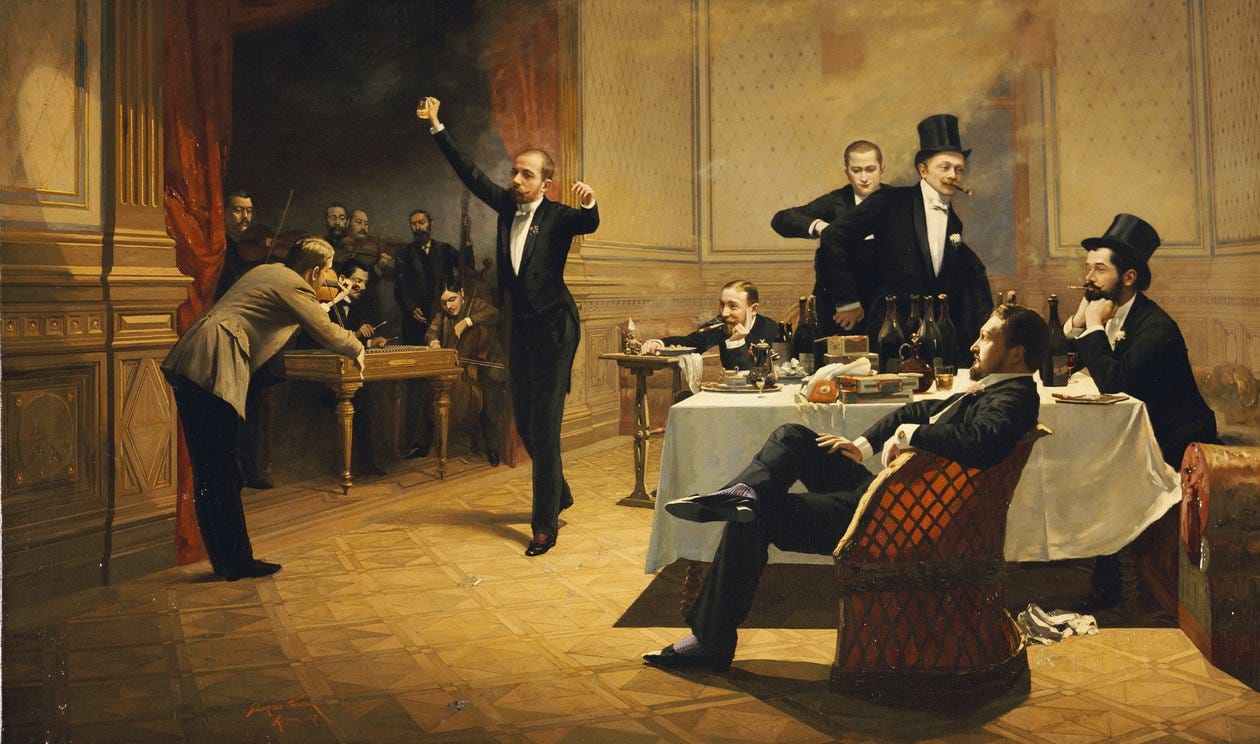
Echo chambers are spaces where a certain view of the world is emphasized, with other perspectives being ignored or even ridiculed. Most often, this idea is connected to political polarization, but this is not the most interesting type of echo chamber. More interesting are positive echo chambers that advance their members to new heights and amplify their collective aspirations. These echo chambers share many of the characteristics that you might associate with negative echo chambers, but there are important differences that make them extremely valuable.
To make this more specific, the type of echo chamber I am talking about is a team with a common goal, convinced of their ideas. This can be a company whose employees are aligned, a lab working towards a scientific vision, or a sports team striving for a championship. In each example, there is a sameness across some dimensions of the individuals. There isn’t the variation one would observe in a random sample of the population.
Broadening one’s view of echo chambers to include these examples leads to the conclusion that much of the innovation and advancement throughout history has occurred when everyone in a community shares the same worldview. This worldview is often irrational to those outside.
There are several advantages of echo chambers.
The first is the density of knowledge and expertise. When a group of people all believe a particular thing is important, they are likely to have more and higher quality information on it. They are also more motivated to make progress on their goals and be persistent when issues arise.
This feeds into the next advantage: those in an echo chamber will be more likely to entertain wild ideas. If those around you share your vision for the future, they will be more likely to go along with ideas that might seem crazy to an outsider. Such ideas are often the ones that push a field forward.
These are compelling reasons to form echo chambers in science, technology, sports, and business. However, any group that remains isolated inevitably develops some distortions in their view of reality. Therefore, it is essential for those in an echo chamber to balance their perspective with a survey of their surroundings. Without a feedback mechanism, unproductive beliefs emerge from the group. These beliefs expose the shortcomings of the echo chamber’s culture, and can threaten to undermine it, destroying its legitimate utility along with its myopia.
The quintessential echo chamber
Consider the group of physicists working on the Manhattan project. This group was almost entirely made up of men from Europe and the United States, many of whom knew each other beforehand. On top of this, they were physically isolated from the rest of society to keep their work secret. This is one of the cleanest examples of an echo chamber in science because it was so carefully orchestrated.
At an intellectual level, the Manhattan project members were quite similar. Many of them came from the same institutions and had been thinking about the same ideas for decades. They were educated in the same manner and expressed similar motivations for their work. Therefore, they shared a mindset and background in the areas most relevant to their goal.
Layered on top of this shared academic and personal background was the impetus for their work. These scientists knew that the Nazis were also aware of the possibility of making an atomic bomb. Many of the core members of the team had fled Germany and knew the evil nature of the Nazis firsthand. Therefore, from the beginning there was a clear and obvious motivation for the project.
Wrapped around all of this was the secrecy required. The physicists lived in the middle of the New Mexico desert for months at a time, unable to speak to those outside about their work. They were almost entirely closed off from the rest of the world. Therefore, their echo chamber extended to multiple meanings of the phrase.
All the shared context and knowledge meant that advancements came quickly. The men selected to be there were at the cutting edge of the field and had the best information of anyone in the world. Furthermore, little time had to be spent convincing anyone of the importance of the goal. In this case the motivation was obvious, but this isn’t always the case and often limits the capabilities of a team. These factors combined with the immense resources behind the project to make progress rapid.
However, the making of the atomic bomb was not a purely positive development. The Manhattan project ushered in the most destructive weapon ever created, capable of creating Armageddon with the push of a button. It is worth thinking about what could have been done differently at these early stages to avoid the geopolitical chess match that we are stuck with today. This is not to condemn those making the decisions at the time, but rather to note that an echo chamber inevitably creates blind spots that impact the outside world. Understanding the dynamics of these groups is highly relevant because many of our best technologies are created by insular groups of highly capable individuals.
Isolation kills courage
A key ingredient to many breakthroughs in human thought is courage. Oftentimes, the scaffolding for an idea exists out in the world and multiple people know about it. In these cases, relative success is determined by who has the courage to pursue the idea with persistence. That is, courage is the bottleneck to many great ideas becoming a reality.
It is extremely difficult to have courage in isolation. In the early stages, the most impactful ideas are often dismissed or ridiculed due to their ambition. Many people might say they are silly, impossible, or unnecessary. In such cases, someone isolated from similar individuals is unlikely to pursue their idea. There will be too many influences in their life telling them not to, explaining why it is a bad idea, and so on. In many cases, these people will be right! A large portion of ideas have a critical flaw that renders them useless. Unfortunately, it is hard to determine ahead of time whether such a flaw exists.
However, occasionally one finds themselves surrounded by people who share the same belief in a crazy idea. At first, this belief might not be rational or easily explained. One could accurately describe this as an echo chamber: a group of people focused on something that is widely dismissed. Nevertheless, this boost in the form of courage is sometimes all that is needed to give someone the motivation to pursue an idea.
Many such ideas will end up failing, but rarely does anything meaningful get explored without courage.
Distance degrades communication
Throughout history, humans have gotten better at storing and transmitting information. We invented writing, then the printing press, and now the internet. Each of these inventions have allowed us to communicate with less ambiguity and more speed. At first glance, you might expect that these technologies would make physical proximity to others less relevant. Indeed, there was much talk post-2020 of the physical location of work losing its importance.
Despite this, technological advancement still overwhelmingly happens in groups of people collocated with one another. For instance, most AI developments occur in San Francisco. In theory, much of this work could be done remotely, but it largely isn’t.
This is because knowledge takes time to propagate and our methods of sending information are still low fidelity. Even though information moves faster, its speed is still limited and therefore circulates within immediate colleagues more quickly. Having a conversation can often substitute for dozens of emails or messages. There are still aspects of human communication that we can’t replicate over the internet.
More importantly, much of the information in an echo chamber never makes it out. Sometimes this is for secrecy, but often it is because this knowledge is difficult to articulate. This often includes techniques and intuitions that build up over years of experience but cannot be transmitted or readily explained. The impossibility of replicating certain results outside specific environments tells us this knowledge exists, but we can’t pinpoint it exactly1.
Transcending the echo chamber
Echo chambers are places where some of the best work is done. Collecting a group of like-minded individuals with a common goal has been a reliable way to get big things done throughout history. The combination of increased courage, information density, and access to esoteric knowledge is a potent mixture for progress and discovery.
Another word for an echo chamber is a bubble. And while bubbles are transparent, they aren’t perfectly so. Even the most flawless bubbles introduce distortions when one looks through them. The intellectual equivalent of this is the strange set of views that sometimes arise from echo chambers. To many on the outside of the echo chamber, these views might seem absurd or untrue, while those inside are convinced. These can be distinguished from the positive ideas that the echo chamber produces, mainly in that they don’t hold up to testing or reality. The emergence of these views is the telltale sign that the echo chamber is too insular and needs to be refreshed.
This essay gives examples of these strange quirks in the Bay Area bubble. These are things like the peculiar culture of investing and startups, the obsession with optimization, and a constant gaze towards the future. In my experience, many of these things are true. In fact, I can see many of them in myself. Nevertheless, these strange people in the Bay Area have created some extraordinarily successful products. They are used and relied on by billions of people. This makes Silicon Valley culture a prime example of the good and bad outputs from an echo chamber.
With this in mind, an obvious question is how to leverage the echo chamber without the negative outputs. The simple answer is that exiting the echo chamber and getting feedback is essential. The worst views that come from echo chambers often arise when those inside don’t have any interface with the broader world and don’t attempt to challenge their own views. In this way, they don’t get feedback on their ideas and can fool themselves. This is particularly destructive in an environment of like-minded individuals who might all have similar blind spots.
This means that those inside the echo chamber must be intentional about exiting their environment. Simple exposure goes a long way towards understanding the differences in priorities, knowledge, and motivation between yourself and others. Doing this deliberately and with an open mind allows you to maintain your convictions about whatever you’re pursuing while not becoming disconnected from the larger context of the world.
Echo chambers are useful environments but have their limits. That is, echo chambers have been unfairly maligned but can also breed bad cultures. The cliché political versions have created an aversion to the very concept of spending significant time with people who agree with you. This view ignores the long history of echo chambers leading to great changes and innovations. These advancements happen because of echo chambers, not despite them.
The limiting factor to an idea changing the world is often not the idea itself, but the amount of courage and knowledge bestowed on the idea’s holder by those around them. Sometimes, an echo chamber is the only way to incubate an idea before it can support itself. Nevertheless, echo chambers can outlive their utility, so those inside must always be wary. Echo chambers are just another social tool humans have invented to leverage our individual abilities. This means you shouldn’t avoid them but instead use them to your advantage, exiting the echo chamber periodically to make sure you haven’t fooled yourself.
Appendix: Political echo chambers
I wanted to spend this essay divorced from the common conception of echo chambers in the political context, but I did some thinking about the relation between positive and negative echo chambers, so here’s how I see it.
A crucial part of a successful echo chamber is an interface with the outside world. In technology, science, and business, this interface comes in the form of customers, readers, or some other form of concrete feedback.
In politics, ideas selected by an echo chamber are only tested when they are implemented at a societal level. Then, the worth of an idea is only determined when history plays out and the results are discovered. Even then, the recounting of history is fraught and rarely tells an objective story. In this sense political echo chambers are so destructive because they lack the concrete, immediate feedback that other echo chambers have. This is their fatal flaw. It is possible for those inside ideological echo chambers to spend time with the other side, but at the end of the day, history is the only judge of each side’s ideas.
Therefore, this difficulty with feedback is at the heart of why political echo chambers are so harmful. It is possible for someone to become inundated with their side’s views, rarely receiving concrete feedback on their merit. This does not seem to be easily fixed, and appears quite fundamental to governing a large, complex society.
Intellectual Dark Matter is a fantastic essay explaining this concept in more depth. In science and engineering there is a lot of attention paid to the ‘breakthrough idea’ or ‘stunning design’, but much of technological innovation is driven by esoteric principles and empirical facts. Oftentimes the only way to learn these is by trial and error.