
Learning from limbo
Taking inspiration from punctuated equilibrium

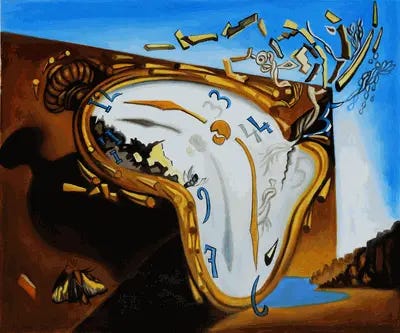
I always come up with my best ideas right before going to sleep. Specifically, it is during the threshold between awareness and sleep right before I’m unconscious. It is this bridge between the conscious and unconscious—this liminal state—that has consistently been generative.
I used to ignore the thoughts I had during this time. I figured that they were simply imposters of good ideas, that they would be nonsensical if I revisited them. At some point, I started writing these ideas down. Most often they would be ideas for essays, solutions to problems I had been contemplating, or reminders of ways to approach an upcoming situation.
At first glance, these ideas sometimes appear useless or irrelevant, but I have found this isn’t always the case. They are some of my most compelling ideas if I assemble them correctly. Analogously to this transition from awareness to sleep, I have recognized the value of in-between states in my life. Such periods where my focus is in dynamic equilibrium have allowed me to grow and understand my goals at a deeper level.
The hypnagogic idea factory
There is something very special about this time sandwiched between awareness and sleep. Officially, it is called hypnagogia. During it, I’m not completely aware of the world around me, and ideas come from all directions. Sometimes they are related to what I was thinking about before going to sleep, but other times they show up unannounced, like a rogue wave.
These ideas take time to develop into something tangible. They start off small, as a suspicion. Slowly, they come into focus, like someone running into view from the horizon. I don’t easily perceive the passage of time from the initial formation of the idea to its completion. In this state, time is demoted to a second-class citizen. Eventually, the swell of the idea becomes too much. I eventually get anxious that I might not catch it on its way out. I rush to my phone or notepad to write it down.
The next morning, I take stock of what I wrote the night before. It is rare for the ideas to be complete nonsense. More often, they feel like hints to a puzzle. It is impossible to recreate the hypnagogic state of mind, so decoding them is like a game.
Nevertheless, some of the ideas I can decode instantly and put into action. These often relate to a pressing problem or obstacle. They might be things like “forgot factor of r in integral, fixes final result” or “try only computing entries near diagonal to make matrix sparse”. These are things I can apply to my next day of work. Such realizations come to me readily during hypnagogia but are totally nonobvious when I’m fully awake.
Others only become useful over the course of weeks or months. These are things like, “essay on Homage to Catalonia and learning about societies through their times of stress” or “learning history through counterfactuals”. There have been several scenarios in which I have looked back at an essay suggestion like this from the past and it has finally clicked. Maybe I didn’t have the right context or scaffolding for the essay at the time, but I had the core of the idea. Perhaps my subconscious needed more time to process it in the background.
Something that makes this state between sleeping and waking so powerful is the decrease in volume in my mind. Sleep is the absence of thought, or in the case of dreaming, the subconscious running wild. Wakefulness is complete conscious control. Before sleep I have not yet succumbed to my subconscious, but I have effectively shut off the planning and executing part of my brain. Therefore, my lower volume thoughts can come to the forefront and be noticed. During the day they are drowned out by my conscious, while during sleep they are concealed by the darkness of sleep or the chaos of dreams.
Finding liminal states in life
More generally, I have found the weeks-to-months long version of hypnagogia to be one of the most satisfying and useful in my life. Specifically, I am talking about the times in my life that I have found my psyche in an ideal mixture of focus and distraction. These might be times when I don’t have a lot going on at school or work, when I am looking to make a career move, or when a stage of my life is coming to an end. I have found these to be the most fertile grounds for genuinely new ideas and deep understandings.
For example, I would describe my time between high school and college as a liminal state. I had already graduated and didn’t have the structure of school, but I was not completely aimless. During this time, I read more books than I had ever before. I was exploring and learning in an intentional manner, but didn’t have a definite goal. It was the first time in my life I took learning seriously outside of school. This gave me lots of good ideas because I was consuming high-quality information and had no choice but to channel this into extemporaneous ideas.
Too often I have convinced myself of the unbeatable value of focus and have lost track of the importance of contemplation and reflection. My most dissatisfying times have come when I have fixated on something I “should” be doing without a clear motivation. These are times when I slip too far into the action mindset. Action is valuable, but only when backed by a coherent analysis and clear intention.
In other words, I have found these liminal periods of my life incredibly fruitful. These are the periods between action and inaction that allow for my deeper motivations and dreams to well up and become obvious.
In this analogy, inaction is the same as sleep1. Necessary and useful for repair, but only to a point. The liminal state gives me access to the relaxation of sleep along with the awareness of consciousness. In the same way, during these periods of organized limbo, I avoid the certainties, deadlines, and requirements that come with action while still actively ideating, writing, reading, and learning. In this way such periods are full of intention and planning, without the scrutiny that comes with a sprint towards a defined goal.
In the same way that the transition to sleep releases my quieter thoughts and ideas, periods of structured exploration reveal my quieter motivations and goals. During phases of action other thoughts and plans are muffled by the volume of the task at hand. Slowing down for a moment silences these and gives the more subtle motivations a chance to be known.
Punctuated equilibrium
This is not to discount action, however. In the same way I wake up the next morning and apply the ideas from the previous night, liminal periods in my life are only as valuable as the action that follows them. Some of the products of these periods are polished and ready for action. It might be a new habit I want to form, a thing to try, or someone I want to meet. Others are not finished and require more work. They might be long term goals or new ideas about the world that don’t have a clear action attached. Like the ream of notes from hypnagogia that I continually revisit, these things are useful to store in my brain but won’t change my behavior in the short term.
These periods of action that follow my structured explorations are substantially more productive and fulfilling than their unconsidered counterparts. During these periods I feel a stronger sense of purpose and motivation. As with anything new and uncharted, there are moments of trepidation, but these are less acute since I know my plan of action is cogent.
I am less likely to get stuck or demotivated with the backing of my meditations. When action is your only mode, it is easy get lost in the work and miss the larger point or purpose of what you’re doing. In the end this turns out to be more demoralizing when results don’t come, or you reach your goal, and it isn’t what you expected.
This model of exploration is analogous to punctuated equilibrium in evolution. Punctuated equilibrium refers to the fact that the evolution of organisms typically occurs in discrete, rapid periods rather than at a constant rate. These periods are rapid on the scale of evolution (~10,000 years), so in the fossil record they appear instant. This is why we observe distinct species in fossils rather that a continuous spectrum of organisms.
Here, the liminal state is the period of stasis in which the species is in genetic equilibrium. Just like in evolution, there is consistent selection, mutation, and navigation of the search space during this period—it just doesn’t lead to a global change in the organism. Eventually, outside pressures or a lucky mutation drive the rapid change of the species into something altogether different. These periods of quick change are analogous to the periods of action that must follow a liminal state.
Any action is only as good as your reaction to its effects. Too often, I have been convinced that action towards something tangible is the only way to live a fulfilling life. As a young person, I have found it easy to become trapped in a hunt for the next accolade, accomplishment, or tier of success. However, I have found that these things are only satisfying when pursued with intention.
One of the best tools I have discovered for generating this intention and genuine motivation is the liminal state. Hypnagogia has afforded me dozens of connections between disparate topics and ways to solve problems that otherwise stumped me. On a larger scale, periods in my life where I have intentionally forgone action to develop a more considered view of my opportunities and mindset have gone a long way towards cultivating my best work. Some might refer to these negatively as limbo, but I look forward to them.
Of course, doing good work and creating things to be proud of require those things—work and creation. Liminal states have been excellent revealers of my worldview and long-term goals, but they can’t accomplish anything by themselves. Inevitably there must be a subsequent stage of action and deliberate effort towards a concrete goal. In my experience, this pairing has led to my most productive periods.
If we really want to make the analogy specific, we can consider sleep to be analogous to vacations or periods of zero action. Therefore, liminal states in life are in between such periods of zero responsibility and sprints with concrete goals and metrics.